Implementing ITIL 4-Aligned Change Enablement and Release Management

Executive Summary

A mid-sized SaaS technology company faced frequent deployment issues, environment instability, and poor visibility across teams. The absence of standardized Change Enablement and Release Management practices led to delays, inconsistent releases, and high post-deployment incidents. To resolve this, an ITSM framework aligned with ITIL 4 best practices was implemented, improving governance, collaboration, and release reliability.

Starting Point

Before implementation, the organization operated with ad-hoc deployments and minimal governance. There were no formal approval workflows, limited documentation, and reactive communication among teams, resulting in frequent production issues and lack of audit readiness.

Findings – The Tangible Gaps

Assessment revealed critical gaps: unstructured change processes, absence of rollback planning, siloed communication, and no visibility into release schedules. Additionally, change types were not differentiated, hindering agile responses and risk management.

Solution Overview

The ITSM team introduced a formal Change Enablement and Release Management framework with ITIL 4 principles. Key actions included defining workflows for Change Requests (Request → Assessment → CAB Approval → Implementation → Post-Review), implementing release planning templates, establishing a RACI matrix, and integrating tools for automated tracking and approvals.

Process Flow Diagrams

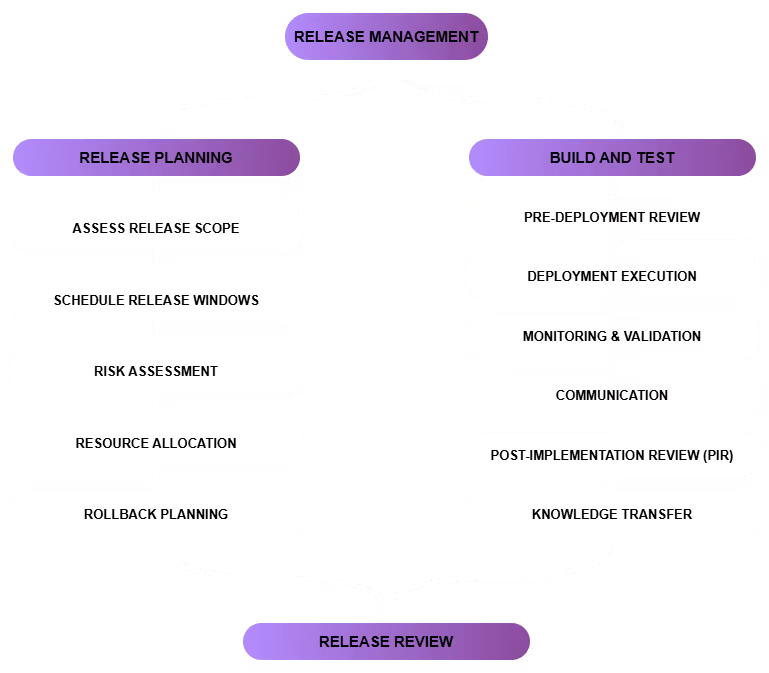
Below are the high-definition diagrams for Change Enablement and Release Management processes:

IT Service Operations
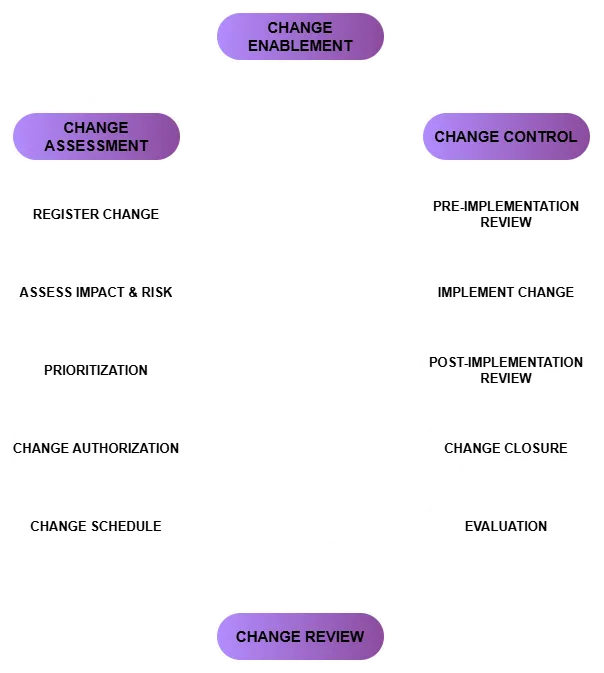
Flowchart of Change Enablement process with four main sections: Change Assessment with steps register change, assess impact & risk, prioritization, change authorization, change schedule; Change Control with steps pre-implementation review, implement change, post-implementation review, change closure, evaluation; central Change Enablement node connecting both sides, leading to Change Review at the bottom.

IT Service Operations

Flowchart showing the release management process divided into release planning steps on the left, build and test steps on the right, and release review at the bottom.

Results

  • 60% reduction in post-release incidents within three months, enhancing system stability and user satisfaction.
  • 100% traceability of changes across all environments, ensuring full auditability and compliance.
  • Improved deployment success rate through standardized validation procedures and robust rollback plans.
  • Enhanced visibility via interactive dashboards and integrated release calendars, supporting better planning and communication.

By streamlining release cycles and introducing a robust, repeatable ITSM framework, the initiative empowers organizations to achieve continuous improvement and scale with confidence.

Case Study · Service Management

Enterprise ITSM Transformation

Aligning IT operations to business outcomes, incident, problem, and change management re-engineered for scale, speed, and measurable improvement.

Incident to change
Processes re-engineered
ITIL 4
Aligned practices
Scale & speed
Built to grow
Measurable
Improvement you can prove
Sector
Service Management
Focus
Enterprise ITSM
Framework
ITIL 4 aligned
Goal
Business-aligned operations
The challenge

IT operations weren't keeping pace with the business.

Incident, problem, and change management had grown reactive and hard to scale, so IT operations were measured by activity rather than by business outcomes.

The organization needed its core service-management processes re-engineered for scale and speed, with improvement that could actually be measured.

  • Reactive incident and problem handling
  • Change and release processes that did not scale
  • IT measured by activity, not business outcomes
  • No consistent way to demonstrate improvement
Our approach

Re-engineer, then measure.

AIM re-engineered the core ITSM processes on ITIL 4 aligned practices, tying IT operations to the outcomes the business cares about.

1

Assess & align

Map current processes and align them to business outcomes and priorities.

2

Re-engineer the model

Redesign incident, problem, change, and release management for scale and speed.

3

Measure & improve

Introduce SLAs, reporting, and continual improvement so gains are measurable.

What we did

The ITSM re-engineering.

Incident management

Faster, consistent handling that limits business disruption.

Problem management

Root-cause focus that reduces repeat incidents over time.

Change & release

Risk-based, structured change that scales without breaking things.

SLAs & reporting

Transparent service levels and reporting the business can see.

Asset & configuration

A reliable view of the estate underpinning every process.

Continual improvement

Service reviews and trend analysis that keep operations improving.

The outcome

Operations built for scale, speed, and proof.

Core service-management processes were re-engineered and aligned to business outcomes, so IT operations run at scale and speed, with improvement that can be measured rather than asserted.

Incident, problem, and change re-engineered

Processes aligned to business outcomes

Service levels and reporting made transparent

A foundation for measurable, continual improvement

Why it matters

Outcomes that hold up.

Aligned to the business

IT operations judged by outcomes, not just ticket volume.

Built to scale

Re-engineered processes hold up as demand and complexity grow.

Measurable improvement

SLAs and reporting turn 'better' into something you can prove.

Modernize your operations

Align IT to business outcomes.

See how AIM re-engineers ITSM for scale, speed, and measurable improvement.